What we know about the death of Iranian supreme leader Khamenei

Ayatollah Ali Khamenei, Iran's hardline supreme leader who ruled the country for almost four decades, was killed in Saturday's joint US-Israeli strikes, Iranian state media confirmed Sunday, prompting celebration among Iranians who opposed his rule and fury from pro-regime loyalists.

CNN Iran's supreme leader, Ayatollah Ali Khamenei, speaks during a mourning ceremony for the deaths of Iranian military commanders and scientists, who were killed in Iran's 12-day war with Israel, in Tehran onJuly 29, 2025. - Office of the Iranian Supreme Leader/Wana News Agency/Reuters

An Iranian TV broadcaster broke down in tears as he confirmed Khamenei had reached "martyrdom" in a strike that Fars New Agency said hit his compound in Tehran as he was "carrying out his duties."

The death of the cleric who repressed millions as he sought to exert Iran's influence in the Middle East and beyond appears likely to plunge the Islamic Republic into the most serious crisis since its establishment, with no clear leader to take his place.

One of Iran's most powerful figures, Ali Larijani, Secretary of the Supreme National Security Council, signaled Iran's defiance on Sunday, vowing to "stab" America in the heart in retaliation.

Here's what we know:

How did he die?

Satellite images from Airbusshowedblack smoke rising from the supreme leader's compound in the capital, Tehran, on Saturday. The images appeared to show that several buildings in the compound had been severely damaged by strikes.

Initially, Iran's Foreign Ministry hadinsistedthat Khamenei was "safe and sound," even as his death was announced by both US President Donald Trump and Israeli Prime Minister Benjamin Netanyahu.

"There are many signs" that Iran's supreme leader is "no longer with us," Netanyahu had said Saturday evening, without elaborating.

Smoke billows above the compound of Ayatollah Ali Khamenei in Tehran on Saturday, February 28. - Airbus

Two Israeli sources told CNN that the strikes targeted senior figures, including Khamenei, President Masoud Pezeshkian, and the armed forces' chief of staff Abdolrahim Mousavi.

Trump said one of the aims of the joint US-Israeli attack was regime change, and he called on the Iranian people to rise up against the government.

However, it was unclear whether such change would result from Khamenei's death, which appeared likely to usher in hard-line rule by the Islamic Revolutionary Guard Corps, experts said.

What led to this?

Khamenei's death comes at a time when Iran is arguably at its weakest since he took power in the 1989. Decades of Western sanctions had already left the country isolated and economically battered before US and Israeli strikes in June 2025 dealt his rule a severe blow.

Just six months later, protests that began over economic grievances quickly turned political, spreading across all 31 of the country's provinces within weeks. The regime responded with a brutal crackdown, killing thousands of protesters and prompting a global outcry, including a threat of intervention from the Trump administration.

That intervention came on Saturday, when Trump said the US military was undertaking a "massive and ongoing operation to prevent this very wicked, radical dictatorship from threatening America and our core national security interests."

President Donald Trump monitors US military operations in Iran, February 28, 2026. Portions of the photo have been blurred by the White House. - The White House/X

Who could replace Khamenei?

Larijani, who been a key adviser to Khamenei, said a temporary leadership structure comprising of the president, the head of the judiciary would soon be in place.

Larijani said Iran had assured leaders in the region that it was not after war with them, but would continue to targeted American bases in Middle Eastern countries.

Advertisement

"It must be made clear once and for all that the Americans cannot bully the Iranian nation," he said.

According to Iran's constitution, an interim three-member council — consisting of the president, the head of the judiciary and a jurist of the country's Guardian Council — would be tasked with carrying out the duties of the leader, until an Assembly of Experts appointed a new supreme leader, according to theMiddle East Institute.

Who could lead Iran next remains a mystery, even to those who have removed him. In January, US Secretary of State Marco Rubio said that "no one knows" who would take over if Khamenei was removed.

Reza Pahlavi, the eldest son of Mohammad Reza Pahlavi, the last shah of Iran, said any attempt to appoint a successor to Khamenei "is doomed to fail from the outset."

How are Iranians reacting?

Cheering could be heard in Tehran as news spread about Khamenei's demise, but as morning broke on Sunday, thousands of people gathered in the capital to wave flags and chant "Death to America."

For protesters who fought for regime change in protests across the country this January, prompting a brutal crackdown, Khamenei needed to go.

The regime employed unprecedented levels of violence, with officials framing the demonstrations as a continuation of an Israeli-American conspiracy against the Islamic Republic.

The protests were the biggest since thedeath of 22-year-old Mahsa Aminiwhile in the custody of the religious police in 2022.

Iranian demonstrators protest the US-Israeli strikes, in Tehran on Saturday. - Majid Asgaripour/WANA/Reuters

In one video obtained by CNN from an eyewitness in Tehran on Saturday as reports of Khamenei's death circulated, the voices of two women can be heard chanting, "Death to the Islamic Republic" and "Long Live the shah," in Farsi, before cheers and whistles erupt.

In a similar video, cheers are heard echoing across a residential neighborhood in the city. In cities around the world, members of the Iranian community took to the streets to celebrate a new era in Iran.

How could this impact the wider Middle East?

Khamenei's death has the potential to trigger the greatest shift in regional dynamics since the Hamas-led attack on Israel on October 7, 2023, after which Israeli Prime Minister Benjamin Netanyahu launched a sweeping campaign to eliminate actors hostile to his country across the Middle East — including Iran and its regional proxies.

It's the second time in less than a century that the United States has acted to remove an Iranian leader from power. In 1953, Mohammad Mossadegh, a secular, democratically elected prime minister, was overthrown in an Iranian army coup backed by the CIA and British intelligence after he nationalized the country's oil industry.

Iran's supreme leader, Ayatollah Ali Khamenei, arrives to cast his vote during parliamentary elections in Tehran on March 1, 2024. - Majid Asgaripour/Wana News Agency/Reuters

That event restored Shah Mohammad Reza Pahlavi to the throne and, after the monarch was deposed in the 1979 Islamic revolution, played a central role in the Islamic Republic's anti-US narrative. It regularly cited by Khamenei as a symbol of US imperialism and the reason for his distrust of the West.

Iran is home to a diverse population of more than 90 million, including Persians, Azeris, Arabs, Baloch and Kurds. Under Khamenei's decades-long rule, the Islamic Republic largely managed to contain civil and ethnic unrest.

But with no clear successor, his death would raise serious concerns about the stability of Iran, as well as the wider region, with potential consequences for the global economy.

For more CNN news and newsletters create an account atCNN.com

What we know about the death of Iranian supreme leader Khamenei

Ayatollah Ali Khamenei, Iran's hardline supreme leader who ruled the country for almost four decades, was killed in S...
Middle East airports closed and thousands of travelers stranded after attack on Iran

LONDON (AP) — Theattack on Iranby the United States and Israel disrupted flights across the Middle East and beyond Saturday as countries around the region closed their airspace and key airports that connect Europe, Africa and the West to Asia were directly hit by strikes.

Associated Press Passengers whose flights were cancelled, wait at the departure terminal of Rafik Hariri International Airport in Beirut, Lebanon, Saturday, Feb. 28, 2026, as many airlines canceled flights due to the conflict involving the United States, Israel and Iran. (AP Photo/Hassan Ammar) FILE -Workers load medical aid onto an Air India plane to be flown to India, at Ben Gurion Airport near Tel Aviv, Israel, May 4, 2021. (Menahem Kahana/Pool Photo via AP, File) Travelers check departure times as many flights are cancelled at Beirut Rafik Hariri International Airport in Beirut, Lebanon, Saturday, Feb. 28, 2026, as many airlines canceled flights due to the conflict involving the United States, Israel and Iran. (AP Photo/Hassan Ammar)

Lebanon Israel Iran US

Airports across the Middle East remained closed Sunday as the conflict moved into its second day. Emirates Airlines suspended all flights to and from Dubai until at least Sunday afternoon. The Qatar airport was closed until at least Monday morning, according to Qatar Airways. Israeli airspace also remained closed Sunday.

The closures have stranded tens of thousands of travelers around the world.

Hundreds of thousands of travelers were either stranded or diverted to other airports Saturday after Israel, Qatar, Syria, Iran, Iraq, Kuwait and Bahrain closed their airspace. There also was no flight activity over the United Arab Emirates, flight tracking website FlightRadar24 said, after the government there announced a "temporary and partial closure" of its airspace.

That led to the closure of key hub airports in Dubai, Abu Dhabi and Doha, and the cancellation of more than 1,800 flights by major Middle Eastern airlines. The three major airlines that operate at those airports — Emirates, Qatar Airways and Etihad — typically have about 90,000 passengers per day crossing through those hubs and even more travelers headed to destinations in the Middle East, according to aviation analytics firm Cirium.

Two airports in the United Arab Emirates reported incidents as the government there condemned what it called a "blatant attack involving Iranian ballistic missiles" on Saturday.

Officials at Dubai International Airport — the largest in the United Arab Emirates and one of thebusiest in the world— said four people were injured, while Zayed International Airport in Abu Dhabi said that one person was killed and seven others were injured in a drone strike. Strikes were also reported at Kuwait International Airport.

Though Iran did not publicly claim responsibility, the scope of retaliatory strikes that Gulf nations attributed to Iran extended beyond the American bases that it previously said it would target.

"For travelers, there's no way to sugarcoat this," said Henry Harteveldt, an airline industry analyst and president of Atmosphere Research Group. "You should prepare for delays or cancellations for the next few days as these attacks evolve and hopefully end."

Airlines that are crossing the Middle East will have to reroute flights around the conflict with many flights headed south over Saudi Arabia. That will add hours to those flights and consume additional fuel, adding to the costs airlines will have to absorb. So ticket prices could quickly start to increase if the conflict lingers.

The added flights will also put pressure on air traffic controllers in Saudi Arabia who might have to slow traffic to make sure they can handle it safely. And the countries that closed their airspace will miss out on the overflight fees airlines pay for crossing overhead.

But Mike McCormick, who used to oversee air traffic control for the Federal Aviation Administration before he retired and is now a professor at Embry-Riddle Aeronautical University, said over the next few days these countries might be able to reopen parts of their airspace once American and Israeli officials share with the airlines where military flights are operating and how capable Iran remains at firing missiles.

"Those countries then will be able to go through and say, okay, we can reopen this portion of our space but we'll keep this portion of our airspace closed," McCormick said. "So I think what we'll see in the next 24 to 36 hours how the use of airspace evolves as the kinetic activity gets more well defined and as the capability of Iran to actually shoot missiles and create additional risk is diminished due to the attacks."

But it is unclear how long the disruption to flight operations could last. For comparison, the Israeli and U.S. attack on Iran in June 2025lasted 12 days.

'No one knows'

The situation was changing quickly and airlines urged passengers to check their flight status online before heading to the airport.

Advertisement

Some airlines issued waivers to affected travelers that will allow them to rebook their flight plans without paying extra fees or higher fares.

Jonathan Escott and his fiance had arrived at the airport in Newcastle, England, on Saturday only to find out that his direct flight to Dubai on Emirates airline was canceled, leaving everyone on the flight stuck there.

Escott left to go back to where he was staying with family, about an hour from the airport, but has no idea when he may be able to travel.

"No one knows," Escott said. "No one really knows what's going on with the conflict, really. Not Emirates, Emirates don't have a clue. No one has a clue."

At least 145 planes that were en route to cities like Tel Aviv and Dubai early Saturday were diverted to airports in cities like Athens, Istanbul or Rome, according to FlightAware. Others turned around and returned to where they took off from. One plane spent nearly 15 hours in the air after leaving Philadelphia and getting all the way to Spain before turning around and returning to where it started.

Numerous airlines canceled international flights to Dubai through the weekend, as India's civil aviation agency designated much of the Middle East — including skies above Jordan, Saudi Arabia and Lebanon — as a high-security risk zone at all altitudes.

Air India canceled all flights to Mideast destinations. Turkish Airlines said flights to Lebanon, Syria, Iraq, Iran and Jordan were suspended until Monday and flights to Qatar, Kuwait, Bahrain, the United Arab Emirates and Oman were suspended.

The airline said additional cancellations may be announced, and many other airlines were suspending flights into the region through the weekend.

Travelers advised to be 'very creative'

U.S.-based Delta Air Lines and United Airlines suspended flights to Tel Aviv at least through the weekend. Dutch airline KLM had already announced earlier in the week that it was suspending flights to and from Tel Aviv.

Airlines including Lufthansa, Air France, Transavia and Pegasus canceled all flights to Lebanon, while American Airlines suspended flights from Philadelphia to Doha.

Virgin Atlantic said it would avoid flying over Iraq, meaning flights to and from India, the Maldives and Riyadh could take slightly longer. The airline already was not flying over Iran and said all flights would carry appropriate fuel in case they need to reroute on short notice.

British Airways said flights to Tel Aviv and Bahrain will be suspended until next week, and flights to Amman, Jordan, were canceled Saturday.

"Travelers should anticipate that there will be a lot of disruptions," Harteveldt said. "To be honest, if you haven't left home, chances are you won't be leaving home if you're supposed to travel to or through these destinations for at least several days, if not longer. And if you are returning home, you will have to be very creative about how you get home."

Levy reported from Harrisburg, Pennsylvania, and Funk reported from Omaha, Nebraska. Associated Press writers Adam Schreck in Bangkok, Sam Metz in Ramallah, West Bank, and Melanie Lidman in Jerusalem contributed.

Middle East airports closed and thousands of travelers stranded after attack on Iran

LONDON (AP) — Theattack on Iranby the United States and Israel disrupted flights across the Middle East and beyond Saturd...
Adebayo scores 24, Larsson adds 20 and Heat hold off Rockets, 115-105

MIAMI (AP) — Bam Adebayo had 24 points and 11 rebounds, Pelle Larsson scored 10 of his 20 points in the fourth quarter and the Miami Heat beat the Houston Rockets 115-105 on Saturday.

Associated Press Houston Rockets forward Kevin Durant, right, loses control of the ball as Miami Heat center Bam Adebayo, left, defends during the first half of an NBA basketball game, Saturday, Feb. 28, 2026, in Miami. (AP Photo/Lynne Sladky) Miami Heat guard Pelle Larsson (9) goes to the basket as Houston Rockets center Alperen Sengun (28) defends during the first half of an NBA basketball game, Saturday, Feb. 28, 2026, in Miami. (AP Photo/Lynne Sladky) Miami Heat guard Tyler Herro (14) and Houston Rockets forward Kevin Durant (7) exchange words during the first half of an NBA basketball game, Saturday, Feb. 28, 2026, in Miami. (AP Photo/Lynne Sladky) Miami Heat guard Tyler Herro (14) shoots over Houston Rockets guard Josh Okogie (20) during the first half of an NBA basketball game, Saturday, Feb. 28, 2026, in Miami. (AP Photo/Lynne Sladky) Houston Rockets head coach Ime Udoka reacts during the first half of an NBA basketball game against the Miami Heat, Saturday, Feb. 28, 2026, in Miami. (AP Photo/Lynne Sladky)

Rockets Heat Basketball

Tyler Herro scored 18, Jaime Jaquez Jr. added 14 and Kel'el Ware had a 13-point, 15-rebound game for the Heat. Andrew Wiggins — who needed eight stitches to close a laceration inside his mouth — had 12 points for Miami.

Kevin Durant finished with 32 points, eight assists and six rebounds for the Rockets, who got 20 points from Amen Thompson and 14 from Reed Sheppard.

Both teams had double-digit leads early; the Rockets ran out to a quick 14-4 edge, the Heat answered with a 37-14 run to take a 41-28 lead. And then things settled down, with the sides staying relatively close the rest of the way.

Neither team had a double-digit lead in the second half until Larsson hit a pair of free throws with 1:52 left for a 113-103 lead.

The Rockets played without Jabari Smith Jr., sidelined with a sprained right ankle. He isn't expected to play in Washington on Monday either.

Advertisement

"We'll target when we return home," said Rockets coach Ime Udoka, who put Sheppard into the starting lineup in Smith's place.

Meanwhile, Miami was without Norman Powell — who'll miss at least one week with a right groin strain, sustained Thursday in a Heat loss at Philadelphia. Herro, who has been working his way back from injury as well, got the start in Powell's spot.

"I feel for Norm because he wants to be out there for all the games, especially these moments right now," Heat coach Erik Spoelstra said. "We'll treat him and we'll see where he is after the week."

Up next

Rockets: Visit Washington on Monday.

Heat: Host Brooklyn on Tuesday.

AP NBA:https://apnews.com/hub/NBA

Adebayo scores 24, Larsson adds 20 and Heat hold off Rockets, 115-105

MIAMI (AP) — Bam Adebayo had 24 points and 11 rebounds, Pelle Larsson scored 10 of his 20 points in the fourth quarter an...
What the death of Iran's supreme leader means

President Donald Trump placed a huge wager by launching amassive air assault on Irandespite having done little to prepare Americans for a new Middle East war with immense risks and years of future consequences.

CNN Iranian Supreme Leader Ayatollah Ali Khamenei delivers a speech in Tehran on April 3, 2022. - Iranian Leader Press Office/Handout/Anadolu/Getty Images

But the death of Iranian Supreme Leader Ayatollah Ali Khamenei opens up a scenario in which Tehran's brutal Islamist regime is overthrown, ending decades of repression that sawthousands of civiliansgunned down in the streets in December and January.

"This is the single greatest chance for the Iranian people to take back their Country," Trump wrote on Truth Social after backing up earlier Israeli reports that Khamenei, whom he described as "one of the most evil people in history" was killed in an air strike.

The demise of Khamenei — the successor to Ayatollah Ruhollah Khomeini, the instigator of the 1979 Iranian revolution — was confirmed by Iranian state media. It is a seismic political event in Iranian history. And it threatens the grip on power of hardline Islamists who turned Iran into a ruthless theocratic dictatorship.

It also adds urgency to one of the most critical questions raised by Trump's assault: Would the removal of top leaders unleash a torrent of institutional reform, or set off uncontrollable political forces that would deepen repression and tear the country apart?

Trump told NBC the attacks had "inflicted tremendous damage."

"At some point they'll be calling me to ask who I'd like (as leader)," Trump said. He added: "I'm only being a little sarcastic when I say that."

No one needs reminding of thetreacherous possibilities of foreign warsthat begin with shock-and-awe violence but can unravel disastrously. Many will view Trump's impulsive attack as a reckless, imperial error. His critics in Congressare already slammingwhat they see as a unilateral, illegal andunconstitutional warthat makes a mockery of democracy.

Iranian counterattacksagainst US allies in Bahrain and Qatar — and the sight of an Iranian drone crashing into a luxury hotelin a tourist area of Dubai— underscored the potential for his bet to spiral out of control.

But while the Middle East usually destroys the preconceptions of outsiders, it's possible that history may eventually remember Trump as the savior of Iranians.

In this handout image released by the White House on X, President Donald Trump monitors US military operations in Iran on Saturday from Mar-a-Lago in Florida. Portions of the photo have been blurred by the source. - The White House/X

The combined US-Israeli attack launched from Israel and a vast US naval armada early Saturday is the most significant twist in a bitter 47-year showdown with the Islamic clerical regime. It seems to end Trump's diplomatic quest for a deal with Iran that now looks like a ruse as a fearsome US force gathered.

Trump's fleeting public arguments ahead of the strikes were incomplete and self-contradictory. He insisted, for instance, that he'd already "obliterated"Iran's nuclear facilities, which formed a key rationale for Saturday's attack.

His claims that the nuclear program andlong-range missilesposed an immediate risk to the United States are overblown and contradict US intelligence assessments reported by CNN. The president even seemed to admit publicly that the threats were not so imminent as to justify immediate US action. "We're doing this not for now. We're doing this for the future," Trump said in a video released from his Mar-a-Lago resort in Florida early Saturday.

But this is now another American operation based on questionable claims of immediate national security peril. In this, it recalls the war waged on false pretenses in Iraq that destroyed President George W. Bush's second term. And it will alienate Trump from sectors of his own MAGA movement.

"It's always a lie and it's always America Last," Trump's former ally Marjorie Taylor Greenewrote on X."But it feels like the worst betrayal this time because it comes from the very man and the admin who we all believed was different and said no more."

The opening that Trump saw and past presidents lacked

If Trump's decision casus belli was impulsive, its broader rationale was familiar. The US and its allies have long tried to thwart Iran's push toward nuclear weapons. They've also been fixated on its long-range missiles and a proxy terror network that made it a pernicious regional power.

But if a crisis point had not been reached, why did Trump act now?

The new dimension in the US-Iran standoff is the weakness of the Tehran regime. This created an opening the US and Israel might rue missing if they didn't act.

Iran's Supreme Leader Ayatollah Ali Khamenei arrives to cast his vote during parliamentary elections in Tehran, Iran, March 1, 2024. - Majid Asgaripour/Wana News Agency/Reuters

Iran has been locked in worsening political turmoil. Khamenei's succession process has been opaque. Iranians are hungry and desperate after decades of iron-fist repression. The economy is splintered by international sanctions and disruption to the most basic services, such as food and water distribution. Israeli attacks have pummeled regional proxies like Hamas and Hezbollah that were once an insurance policy against US and Israel action.

Although Iran launched frightening counterattacks by firing missiles against Israel and US allies in the Gulf, the potential costs of a US effort to destroy the regime are perhaps lower now than they have ever been.

When Trump called on Iranians to revolt against their government in his message, he was trying to leverage these political factors to catalyze change.

"The factor that clearly seems to have changed is the level of hatred that people of Iran have for the regime, given the massacre that happened back in January," said Alex Vatanka, a senior fellow at the Middle East Institute. "So if you're sitting in the White House, or if you're sitting in Jerusalem, you look at this as a window of opportunity. The regime is weak. It's not just the sanctions … it's the fact that they did what they did and kept massacring their own people, and so that creates a window of opportunity."

The president also needed to rescue himself. His repeated warnings that the US would protect protesters in Iran during the recent uprising meant that a failure to act risked deepening Tehran's repression and shattering his own credibility. And he makes no secret of being motivated by vengeance. He had frequently warned Iran was steeped in the blood of Americans following years of terror attacks and the Tehran-backed militia killings of US soldiers during the occupation of Iraq.

And Trump, more than most of his modern predecessors, is enthralled by the ruthless application of American military power.

A commander in chief nearing 80 is also a man in a hurry. The chance to be the president who solved the Iran conundrum that bedeviled every predecessor since Jimmy Carter must have been tantalizing. But his hubris will leave his legacy condemned by history if he's made a bad bet.

Advertisement

Smoke rises following an explosion in Tehran after Israel and the US launched strikes on Iran on Saturday. - Majid Asgaripour/WANA/Reuters

Consequences could linger for years

Trump has not just committed the United States to toppling a foreign government. He's trying to end a revolution — a process that he will struggle to influence, especially in the absence of US ground troops.

Sen. Jack Reed, the top Democrat on the Armed Services Committee, warned of "consequences that will outlast this presidency."

"Against the clear wishes of the American people, President Trump has thrust our nation into a major war with Iran — one he never made a case for, never sought congressional authority for, and for which he has no endgame," Reed said in a statement.

Several key factors will shape the conflict in the short term.

► Will US and Israeli strikes succeed in taking out the top level of Iranian leaders?

► Now that Khamenei is dead, will Iranians heed Trump's call to take to the streets, take over their country and end the Islamic Revolution's stranglehold?

► The possibility of a regional conflagration remains acute. But do Iran's initial reprisals — which were alarming but limited — betray diminished capability or a desire to keep options in reserve?

► Eyes will soon turn to Trump's staying power. The president prizes quick wins; he is adept at tearing things down, but has shown less capacity for building something in their place. He told Axios on Saturday, however, that he was ready to stay the course if necessary. "I can go long and take over the whole thing, or end it in two or three days and tell the Iranians: 'See you again in a few years if you start rebuilding (nuclear facilities).'"

► The domestic response to Trump's move will also be important. He's saddled with hisworst-ever approval ratingsahead of November's midterm elections. Polls show that majorities of Americans believe he doesn't share their priorities.

What could go wrong?

The best day for the United States in recent wars — in Afghanistan and Iraq, for instance — has come early in a conflict where the massive, overwhelming advantage of US military force looks decisive.

Even if its regime is overthrown and top leaders are killed, a transition to a democratic, nonthreatening Iran may still be a pipe dream.

If the authority of central government breaks down, anarchy could erupt. Trump and Israeli Prime Minister Benjamin Netanyahu seem to have calculated this is a worthwhile risk to remove Khamenei. But it could seed decades of regional instability.

"I think the calculus, is that in some sense, stars have aligned with regard to the weakness of the regime internally — the kind of battle that it's facing domestically, plus its regional defeats and its reduced capacity for retaliation," said Ian Lesser, a distinguished fellow at the German Marshall Fund of the United States. "Now, all of that may not add up to a change in the regime. This is a strong and, in some ways, resilient country, but what is the risk?"

While Lesser said there's little chance of a regime worse than the current one, the danger persists that Trump's operation is "inconclusive, and that the regime strikes out in ways that may only manifest themselves months and years to come, in terms of support for proxies, in terms of support for state-sponsored terrorism in the West generally."

Another danger — seen as the most likely scenario by US intelligence assessments cited by CNN — is that the clerical regime could simply be replaced by equally hardline remnants of the Islamic Revolutionary Guard Corps. A classic strongman Middle East government might mean imminent threats to the US or Israel. But it would fall far short of the popular awakening Trump hopes for.

People walk near a mural featuring images of Iran's Supreme Leader Ayatollah Ali Khamenei and leader of Iran's 1979 Islamic Revolution Ayatollah Ruhollah Khomeini, on a street in Tehran February 17. - Majid Asgaripour/Wana News Agency/Reuters

The worst-case scenario is a disintegration of central control in Tehran over major cities that leads to armed factions creating rival fiefdoms that pose a serious risk of civil war and national fracturing. Refugee crises could follow and destabilize the region for years to come.

There's little in Trump's mindset or conduct that suggests he's got the depth or staying power for such an outcome.

Still, some Republicans are adamant the US will not get sucked into another long-term conflict that would strain American resources and the public's will.

"I don't know why anybody would say this is going to be a forever war. I think it's going to be pretty short," Texas Sen. John Cornyn told CNN. But Iran has a much simpler goal than Trump: an outcome that ends with the current regime in place equals victory.

"Iran has prepared itself for a long war," an Iranian source with knowledge of the country's military strategy told CNN's Frederik Pleitgen.

It's too early to predict a quagmire.

But this new war already has its defining irony. Trump — who rose to power on a tide of angst over foreign wars — is now the latest president to willingly plunge into a new Middle East conflict.

"He has so much respect for American force, but that's just part of the equation," Vatanka said. "American force without any strategic objective in mind is essentially useless. You can just blow up anything you want, but doesn't mean much. That doesn't mean you're going to end up with a better product."

This story and headline have been updated with additional developments.

For more CNN news and newsletters create an account atCNN.com

What the death of Iran’s supreme leader means

President Donald Trump placed a huge wager by launching amassive air assault on Irandespite having done little to prepare...
Joel Embiid out at least 3 games after MRI reveals oblique injury

Joel Embiid has been an intermittent presence for the Philadelphia 76ers this season. He's about to have another multi-game absence.

Yahoo Sports

An MRI revealed a right oblique strain for the former MVP and he will be out for at least the next three games,the team announced Saturday via PHLY's Derek Bodner. He will be re-evaluated following Philadelphia's game against the Utah Jazz next Wednesday.

Advertisement

Those three absences will bring Embiid's missed games tally up to 29 this season.He was already awards-ineligible this seasonandmissed five straight earlier this month with a sore right knee and shin issue.

Embiid had a slow start to the season while managing a left knee injury but has been otherwise effective when he's on the court, averaging 29.5 points, 8.2 rebounds and 4.5 assists per game since the start of 2026.

Despite missing Embiid for nearly half their games, the Sixers sit in sixth place in the Eastern Conference at 33-26. They are 12-14 in games he hasn't played.

Joel Embiid out at least 3 games after MRI reveals oblique injury

Joel Embiid has been an intermittent presence for the Philadelphia 76ers this season. He's about to have another m...
Who is Taylen Green? Arkansas QB sets records with vertical, broad jumps before running 4.36 at NFL combine

Arkansas' Taylen Green broke a pair of NFL scouting combine records Anthony Richardson Sr. set in 2023 before the Indianapolis Colts selected him No. 4 overall in the draft.

Yahoo Sports

The 6-foot-6, 227-pound Green logged a 43.5-inch vertical and leapt 11 feet, 2 inches in the broad jump, uncharted territory for quarterbacks in the event.

For reference, Richardson — listed at 6-foot-4, 244 pounds — posted a 40.5-inch vertical and flew 10 feet, 9 inches in the broad jumpthree years ago in Indianapolis' Lucas Oil Stadium.

Then Green ran a 4.36 40-yard dash, the second-fastest time any QB has ever clocked at the combine.

NFL Network flashed a graphic on its broadcast comparing Green to Pittsburgh Steelers wide receiver DK Metcalf, but analyst Charles Davis quickly dismissed the notion that Green is entertaining a position switch right now.

"I just asked him very simply, 'With the day you're having and your build and everything else, have people approached you about doing wide receiver drills?'" Davis reported on NFL Network.

"[Green] said, 'No, they have not.'

"I said, 'What would you do if people did approach you to do wide receiver drills?' ... He said, 'Absolutely not. I'm a quarterback.'"

It's a sentiment many athletic quarterbacks before him have shared, most notably two-time NFL MVP Lamar Jackson, and admirably so. But it's important to note that Jackson was a Heisman Trophy winner at Louisville. Green, on the other hand, didn't achieve nearly the same level of success in the collegiate ranks.

Interestingly enough, though, both played under Bobby Petrino.

Where did Taylen Green come from?

Green was a three-star prospect coming out of Lewisville High School in Texas. While there, he set the school record in the long jump and put up some nice dual-threat numbers on the gridiron. As a senior, Green threw for 22 touchdowns and ran for seven more scores.

He was the No. 660 overall recruit, including the 48th-highest rated QB, in the 2021 class,according to the Rivals industry ranking.

Green committed to Boise State, where he spent the first three seasons of his college career. He redshirted in 2021 and started a combined 22 games from 2022-23.

Advertisement

[Watch Yahoo Sports Network]

As a redshirt freshman in 2022, he eventually took over the QB1 job and helped the Broncos notch their first double-digit win season in three years. Green totaled 24 touchdowns — 14 passing and 10 rushing — and tossed only six picks, earning Mountain West Freshman of the Year honors.

His 61.3% completion percentage from that season ended up being a single-season career high.

In 2023, Green piloted Boise State to a Mountain West Conference title. Ahead of the 2024 season, he transferred to Arkansas, where he continued to showcase his athleticism but also inconsistency.

In six of the 12 games he played in this past season, he completed less than 60% of his passes. Additionally, Green was picked off 11 times, and Arkansas finished 2-10, although the Razorbacks were undeniably hamstrung by a defense that was eighth-to-last in the country with 33.8 points per game allowed in 2025. Still, Green's persistent scoring production, through the air and on the ground, is noteworthy.

A record-breaking QB workout in Indy

NFL analyst Lance Zierlein described Green's delivery as "long" and "unorthodox"in his NFL.com prospect profilewhile also pointing out the 23-year-old signal-caller's tendency to put the ball in harm's way.

That said, it's clear Green can create off script, and he has the talent to make all the throws and perhaps the running ability to make up for those he misses.

But he needed a head-turning performance in the combine to draw Day 2 or early Day 3 interest. He delivered Saturday.

AsRichardson has proven so far in the NFL, however, athleticism, no matter how impressive, is just part of a complicated equationat the sport's most prestigious position.

Ultimately, Green's consistency as a passer, or lack thereof, will likely make or break his pro career.

Who is Taylen Green? Arkansas QB sets records with vertical, broad jumps before running 4.36 at NFL combine

Arkansas' Taylen Green broke a pair of NFL scouting combine records Anthony Richardson Sr. set in 2023 before the Ind...
Iranian state media: 85 killed after missile blew up all-girls school

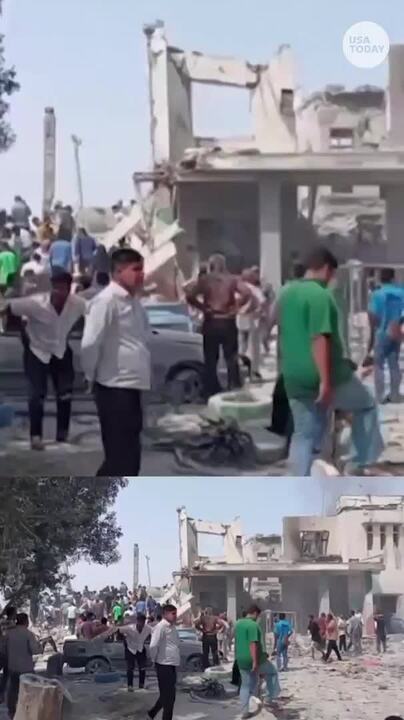
Iranian media and officials are reporting that ajoint U.S.-Israeli attack on Iranstruck a girls' primary school in the southern part of the country, killing 85 people.

USA TODAY

The IRNA news agency said the majority of the casualties are children at the Shajareh Tayyebeh all-girls' school in Minab. Dozens more are unaccounted for, the state-run news agency said.

A local Iranian prosecutor was quoted in the IRNA report. Reuters could not independently confirm the reports. US and Israeli military forces did not immediately respond to a request for comment.

According toPresident Donald Trump, the United States joined Israel inlaunching military strikes, as well as "major combat operations," to target Iran's missile capabilities.

"Our objective is to defend the American people by eliminating imminent threats from the Iranian regime, a vicious group of very hard, terrible people," Trump said, calling the strikes "a massive and ongoing operation."

While much remains unclear regarding the overall impact of the strikes, Reuters reported, citing state media, at least 40 people died due to the strike on the girls' school in Minab in southern Iran. Separately, state news agency IRNA reported one student was killed and two others injured in an airstrike on a school in Abyek, located in northwest Iran.

This picture obtained from Iran's ISNA news agency shows the site of a strike on a girls' school in Minab, in Iran's southern Hormozgan province, on February 28, 2026. The United States and Israel launched strikes against Iran on February 28, with Israel's public broadcaster reporting that supreme leader Ayatollah Ali Khamenei had been targeted, as the Islamic republic retaliated with barrages of missiles at Gulf states and Israel. Black smoke rises from a destroyed building at a school where, as the state media reports, several people were killed in an Israeli airstrike, following strikes by the United States and Israel against Iran, in Minab, Iran in this screengrab obtained from a social media video released on February 28, 2026. This picture obtained from Iran's ISNA news agency shows the site of a strike on a girls' school in Minab, in Iran's southern Hormozgan province, on February 28, 2026. The United States and Israel launched strikes against Iran on February 28, with Israel's public broadcaster reporting that supreme leader Ayatollah Ali Khamenei had been targeted, as the Islamic republic retaliated with barrages of missiles at Gulf states and Israel. This picture obtained from Iran's ISNA news agency shows the site of a strike on a girls' school in Minab, in Iran's southern Hormozgan province, on February 28, 2026. The United States and Israel launched strikes against Iran on February 28, with Israel's public broadcaster reporting that supreme leader Ayatollah Ali Khamenei had been targeted, as the Islamic republic retaliated with barrages of missiles at Gulf states and Israel. This picture obtained from Iran's ISNA news agency shows the site of a strike on a girls' school in Minab, in Iran's southern Hormozgan province, on February 28, 2026. The United States and Israel launched strikes against Iran on February 28, with Israel's public broadcaster reporting that supreme leader Ayatollah Ali Khamenei had been targeted, as the Islamic republic retaliated with barrages of missiles at Gulf states and Israel. People gather at the site of a destroyed building at a school where, as the state media reports, several people were killed in an Israeli airstrike, following strikes by the United States and Israel against Iran, in Minab, Iran in this screengrab obtained from a social media video released on February 28, 2026. People gather at the site of a destroyed building at a school where, as the state media reports, several people were killed in an Israeli airstrike, following strikes by the United States and Israel against Iran, in Minab, Iran in this screengrab obtained from a social media video released on February 28, 2026.

Dozens killed at girls' school in Iran amid US-Israeli strikes, state media reports

What is Shajareh Tayyebeh?

Shajareh Tayyebeh is an all-girls' school located in the southern Iranian town of Minab. Minab is in Hormozgan Province, which is along the Strait of Hormuz, a strategic international shipping lane, according to theNew York Times.

Hossein Kermanpour, a spokesman for Iran's health ministry,shared an X post on Feb. 28, calling the majority of those killed at the school "young child martyrs."

"God knows how many more children will be pulled out of the rubble," he wrote in the social media post. "May God give their families strength and patience."

Advertisement

When the strike hit, Shajareh Tayyebeh, described as an elementary school, washolding its first of multiple rotating school shifts, according to Hengaw, a Norway-based organization focusing on human rights violations in Iran. The group added that around 170 students are enrolled in the school's morning shift; however, it is unclear how many were in the building during the strike.

Israel shuts down its schools as Iran launches retaliatory missiles

Following the strikes on Saturday morning, Israel announced that it had shut down schools and workplaces, moved hospital patients to underground facilities and banned public gatherings, Reuters reported.

The move comes as Iran began launching retaliatory missiles at Israel, prompting Defence Minister Israel Katz to declare a state of emergency across the country, warning the public of Iranian missile and drone attacks, per Reuters.

So far, there have been few reports of damage or injuries from Iran's initial missile attacks. Israelis typically have access to bomb shelters and are warned to hurry to them by a nationwide alert system.

Smoke rises from a burning building hit by an Iranian drone strike, after Israel and the U.S. launched strikes on Iran, in Seef district, Manama, Bahrain, February 28, 2026.

'I did not campaign for this,' Marjorie Taylor Greene says

In response to the reported deaths and decimation of Shajareh Tayyebeh, formerRep. Marjorie Taylor Greene, who removed herself fromTrump's "Make America Great Again" (MAGA) movementlast year,shared an X post voicing her condemnationof what transpired at the girls' school.

"I did not campaign for this. I did not donate money for this. I did not vote for this, in elections or Congress. This is heartbreaking and tragic. And how many more innocent will die? What about our own military?"

Greene concludedher post saying, "This is not what we thought MAGA was supposed to be. Shame!"

This story was updated to add new information.

Reuters contributed to this story.

This article originally appeared on USA TODAY:Iranian girls' school decimated, dozens killed. What we know

Iranian state media: 85 killed after missile blew up all-girls school

Iranian media and officials are reporting that ajoint U.S.-Israeli attack on Iranstruck a girls' primary school in th...
Mexican authorities hand over body of 'El Mencho' to his family

MEXICO CITY (AP) — Mexican authorities returned the body ofNemesio Oseguera Cervantes, known as "El Mencho," to his family after he was killed by the Mexican army last week, officials said on Saturday.

Associated Press

In a brief note on X, the Attorney General's Office said that it handed over the body of El Mencho after completing all the necessary procedural protocols.

"Genetic tests were carried out to confirm that there were indeed blood ties between the person who requested the release and the deceased," the organ said.

The killing of the country's most powerful drug lord was met with a wave of retaliatory violence in some 20 states. More than 70 people were killed.

Advertisement

The violence has fueled fears that the bloodshedcould hurt tourismahead of theFIFA World Cuplater this year.

The U.S. State Department had offered a reward of up to $15 million for information leading to the arrest of El Mencho. TheJalisco New Generation Cartel, which he ran, is one of the most powerful and fastest growing criminal organizations in Mexico and began operating around 2009.

In February 2025, the Trump administration designated the cartel as a foreign terrorist organization.

The drug lord's death was the Mexican government's biggest prize yet to show the Trump administration in its efforts to crack down on the cartels.

Mexican authorities hand over body of ‘El Mencho’ to his family

MEXICO CITY (AP) — Mexican authorities returned the body ofNemesio Oseguera Cervantes, known as "El Mencho," to...
Pakistani and Afghan forces clash as diplomatic efforts intensify

KABUL, Feb 28 (Reuters) - Fighting between Pakistan and Afghanistan's Taliban military entered its third day on Saturday as foreign governments expressed increasing concern and called for urgent talks.

Reuters An Afghan man stands next to a damaged car following airstrikes, amid the conflict between Afghanistan and Pakistan, in Kandahar, Afghanistan, February 28, 2026. REUTERS/Stringer An Afghan man walks past a damaged wall following airstrikes, amid the conflict between Afghanistan and Pakistan, in Kandahar, Afghanistan, February 28, 2026. REUTERS/Stringer A police officer controls traffic flow as a security measure, following exchanges of fire between Pakistani and Afghan forces, along a road leading to the airport in Karachi, Pakistan, February 28, 2026. REUTERS/Asim Hafeez Taliban soldiers stand on top of a their post as they guard near the Pakistan-Afghanistan border, in Khost province, Afghanistan, February 27, 2026. REUTERS/Stringer An army soldier stands guard at a post at the Friendship Gate, following exchanges of fire between Pakistan and Afghanistan forces, at the border crossing between the two countries in Chaman, Pakistan February 27, 2026. Picture taken with a mobile phone. REUTERS/Abdul Khaliq Achakzai Zabihullah Mujahid, Taliban spokesperson, gestures during a press conference, following an escalation in cross-border tensions with Pakistan, in Kandahar, Afghanistan, February 27, 2026. REUTERS/Stringer

Aftermath of airstrikes amid Afghanistan-Pakistan conflict, in Kandahar

Pakistan's strikes on Friday hit Taliban military ‌installations and posts, some of them in Kabul and Kandahar, in one of the deepest Pakistani incursions into ‌its western neighbour in years, officials said.

Islamabad accuses the Taliban of harbouring Tehreek-e-Taliban Pakistan (TTP) militants, who it says are waging an insurgency inside Pakistan, a ​charge the Taliban denies.

Pakistan said it was responding to cross-border assaults, while Kabul complained of a breach of its sovereignty, saying it remained open to dialogue but warning that any wider conflict would have serious consequences.

PAKISTAN-AFGHANISTAN FIGHTING RAISES FEAR OF LONG WAR

The fighting has raised the risk of a protracted conflict along the rugged 2,600-km (1,600-mile) frontier.

Diplomatic efforts gathered pace late on Friday as Afghanistan ‌said its foreign minister, Amir Khan Muttaqi, ⁠had spoken with Saudi Arabia's Prince Faisal bin Farhan about reducing tensions and keeping diplomatic channels open.

The European Union urged both sides to de-escalate and engage in dialogue, while the United ⁠Nations urged an immediate end to hostilities.

Russia urged a return to talks, while China said it was deeply concerned and ready to help ease tensions.

The U.S. State Department said the U.S. supported Pakistan's right to defend itself against attacks by the Taliban.

Advertisement

A U.S. official, ​speaking on ​condition of anonymity, said Washington did not view Pakistan as the ​aggressor and that Islamabad was under pressure to ‌address security challenges.Exchanges of fire continued along the border overnight.

Pakistani security sources said an operation dubbed "Ghazab Lil Haq" was ongoing and that Pakistani forces had destroyed numerous Taliban posts and camps. Reuters could not independently verify the claims.

Both sides have reported heavy losses. Pakistan said 12 of its soldiers and 274 Taliban had been killed while the Taliban said 13 of its fighters and 110 Pakistani soldiers had died.

Taliban deputy spokesman Hamdullah Fitrat said 52 civilians had been killed and 66 wounded ‌in the Khost and Paktika provinces. Reuters could not verify the ​figures.

Pakistani Defence Minister Khawaja Muhammad Asif said Islamabad's patience had run out ​and described the fighting as "open war".

Taliban Interior Minister Sirajuddin ​Haqqani said in a speech that the conflict would be "very costly", and that Afghan forces had ‌not deployed broadly beyond those already engaged.

He said ​the Taliban had defeated "the world" through "unity ​and solidarity" and through "great patience and perseverance" rather than superior military power.

Pakistan's military capabilities far exceed those of Afghanistan, with a standing army of hundreds of thousands and a modern air force.

The Taliban lacks any conventional air ​force and relies largely on light ‌weaponry and ground forces.

However, the Islamist group is battle-hardened after two decades of insurgency against U.S.-led forces before ​returning to power in 2021.

(Reporting by Mohammad Yunus Yawar in Kabul and Ariba Shahid in Karachi; Additional ​reporting by Trevor Hunnicutt in Washington; Editing by Sam Holmes)

Pakistani and Afghan forces clash as diplomatic efforts intensify

KABUL, Feb 28 (Reuters) - Fighting between Pakistan and Afghanistan's Taliban military entered its third day on Satur...


GEAR MAG © 2015 | Distributed By My Blogger Themes | Designed By Templateism.com