
WASHINGTON − Who is an American?
That's the fundamental question theSupreme Courtwill take up on April 1 when it debates PresidentDonald Trump'sability to sharply restrictwhich children born in the United States are automatically citizens.
The court's ruling is likely to land shortly before the nation celebrates its 250thanniversary, adding to the significance of a case that was already a blockbuster.
It'sanother opportunityfor theSupreme Courtto weigh in on the expansive authority Trump has claimed since returning to the White House last year.
Can he change the definition ofbirthright citizenshipwith a stroke of his pen? "What the president's executive order attempts to do is to rewrite citizenship as we have known it since the late 19thcentury," said César Cuauhtémoc García Hernández, an expert on immigration law at Ohio State University College of Law.
More:Will the majority-Catholic Supreme Court listen to the church on immigration?


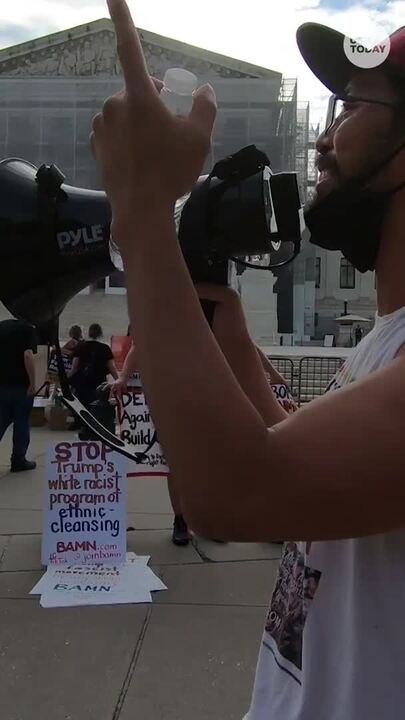
See people outside Supreme Court demonstrate for birthright citizenship in May 2025
What does the Constitution say about birthright citizenship?
The 14thAmendment, ratified in 1868, says: "All persons born or naturalized in the United States, and subject to the jurisdiction thereof, are citizens of the United States and of the State wherein they reside."
That's long been interpreted to include everyone except children born to diplomats, to invading military forces and – initially – to Native Americans, who later got birthright citizenship under a 1924 law.
In alandmark rulingin 1898, the Supreme Court upheld the citizenship of a San Francisco-born man – Wong Kim Ark − whose Chinese parents were barred from becoming citizens under the laws of the time.
And immigration laws enacted in the mid-20thcentury used nearly identical language as the 14thAmendment.
But Trump says that language has been misread.
He argues that "subject to the jurisdiction thereof" rules out children born to parents who aren't citizens, because they may feel loyal to a foreign country even if they have to follow U.S. laws while they're here. The Supreme Court's 1898 decision, the Justice Department says, applied to children whose parents had a "permanent domicile and residence in the United States."
Go deeper:President Trump's winning streak at the Supreme Court is about to get tested

What is Trump's policy?
On his first day back in office, Trumpdirectedfederal agencies not to recognize the citizenship of babies born in the United States who do not have at least one parent who is an American citizen or lawful permanent resident, also known as a "green card" holder.
Thatexecutive order– titled "Protecting the Meaning and Value of American Citizenship" – is one of more than 500policy changesfrom the administration that longtime immigration law scholar Stephen Yale-Loehr said are among the most sweeping immigration restrictions in modern U.S. history.
Yale-Loehr, a retired Cornell Law School professor, said the policies are "both a different magnitude and different quality" than what Trump pushed in his first administration.
But while presidents have a lot of latitude over who is allowed into the United States, defining who is an American by birth is different.
"Historically, all Supreme Courts have been deferential to presidents on immigration because immigration touches on sovereignty and foreign affairs," he said. "This involves a clause in the Constitution itself."
More:Countries in the Americas grant birthright citizenship. What happens if they revoke it?

Round two at the Supreme Court
The Supreme Court took up Trump's birthright citizenship executive order last year, but only to decide whether lower courts had gone too far in blocking its implementation while the order is being challenged.
In a6-3 decisionin June, the court rejected the way judges had put Trump's order on ice but left open another path.
And it wasn't long before that path was used.
In July, a federal judge in New Hampshireblockedthe citizenship order in a class-action lawsuit brought by affected children and their parents.
Judge Joseph Laplante said the order likely contradicts the 14thAmendment "and the century-old untouched precedent that interprets it." He also said it probably violates a federal law that includes similar language.
More:Springsteen's 'Born in the U.S.A.' joins Trump citizenship court fight
Who is challenging Trump's policy?
The parents representing their children in the lawsuit include a woman from Honduras who has lived in the United States since 2024 and gave birth months after Trump signed his executive order.
Advertisement
Identified by the pseudonym "Barbara," the woman said in court filings she's seeking asylum from gang activity in Honduras, and her family has become part of the local community in New Hampshire.
Another mother challenging the order came to the United States from Taiwan in 2013 on a student visa and is applying for a work visa. She and her husband have four children, three born in the United States before Trump's executive order and one born after.
"My husband and I ended up building a life here," the woman, known as "Susan," said in a court filing. "My baby has the right to citizenship and a future in the United States."

More:Trump ramps up attack on birthright citizenship case in Supreme Court
'Foundational to who we are as a nation'
The American Civil Liberties Union, which is representing the immigrants, is arguing to the Supreme Court that birthright citizenship "is foundational to who we are as a nation."
"This case is about the administration's effort to redefine what America is," said Cody Wofsy, a lawyer with the ACLU Immigrants' Rights Project. "Going all the way back to the country's founding, the rule had been that if you're born in this country, you're an American."
The 14th Amendment's citizenship clause was passed after the Civil War to repudiate the Supreme Court's infamous 1857 Dred Scott decision that a Black person was not a citizen of the U.S. But the clause covers "all persons."
Under Trump's policy, roughly 255,000 children born on U.S. soil each year would start life without U.S. citizenship,accordingto the Migration Policy Institute.
Trump, and those backing his executive order, argue he's trying to protect American citizenship from being devalued.
"This debate is not just about immigration policy; it's about the meaning of American citizenship," Sen. Eric Schmitt, a Republican from Missouri, said during a recentSenate hearingon the issue. "If citizenship loses its meaning, the foundations of the republic begin to weaken from within."
More:What history reveals about Trump's move to limit birthright citizenship

What defines citizenship?
Schmitt said citizenship needs to be rooted in allegiance to the national community and shouldn't apply to the children of people who are in the country as students, tourists or without the government's permission.
But Alejandro Barranco, a U.S. Marine Corps veteran whose father was violently arrested by immigration agents last year because he was living in the United States without legal status, said he's proof that belonging to a nation is defined by someone's contribution − not their ancestry.
"I was born here. I grew up here. I served here," Barranco told the Senate Judiciary Committee. "I love this country, and I have shown that through my actions."

While a 2025Pew Research Center pollfound near unanimous agreement that people born in the country to U.S.-born parents or to parents who immigrated legally should be citizens, the public was evenly divided over birthright citizenship for people whose parents immigrated illegally.
Half of adults surveyed said those babies should have citizenship and 49% disagreed.
More:USA Happy Baby, birth tourism and a blockbuster Supreme Court case
How might the Supreme Court rule?
One reason the Supreme Court often agrees to take a case is because lower courts have split over the issue.
Because none of the multiple judges who have reviewed Trump's policy have found it lawful, the easier route for the Supreme Court would have been to reject the administration's appeal, said García Hernández, the immigration law expert at Ohio State University College of Law.
"But that's not what they have done," he said. "That suggests that there are some justices who are inclined to agree with the president."

The most important case of the century?
The justices, however, may also have taken the case, Trump v. Barbara, to give a definitive answer.
Eric Wessan, an attorney with the Iowa Attorney General's office − which joined a legal brief written by GOP attorneys general backing Trump − said it's possible the court will choose a narrower route.
Rather than ruling on the original meaning of the 14thAmendment, he said, the justices could simply say that an executive order can't override the 1952 Immigration and Nationality Act, which uses similar language that was well understood at the time.
"That's kind of what I would call a Chief Justice (John) Roberts special, where he can avoid a really difficult constitutional holding while at the same time reaffirming the supremacy of Congress," Wessan said during awebinarpreviewing the arguments.
In a filing to the Supreme Court, prominent constitutional law scholar Akhil Reed Amar urged the justices not to avoid addressing the constitutional question by focusing solely on the Immigration and Nationality Act. He said the case could be the most important of the century.
"All constitutional issues are important," Amar wrote, "but few rival the constitutional issues in this case: Who is an American? May a president ignore the Constitution itself? May a president defy valid congressional statutes and make himself a dictator of all law?"
This article originally appeared on USA TODAY:Supreme Court to decide if Trump can redefine birthright citizenship