
JASPER, AL — On a brisk December morning inWalker County, Alabama, the temperature in Sheriff Nick Smith's office is a welcome shelter from the cold.

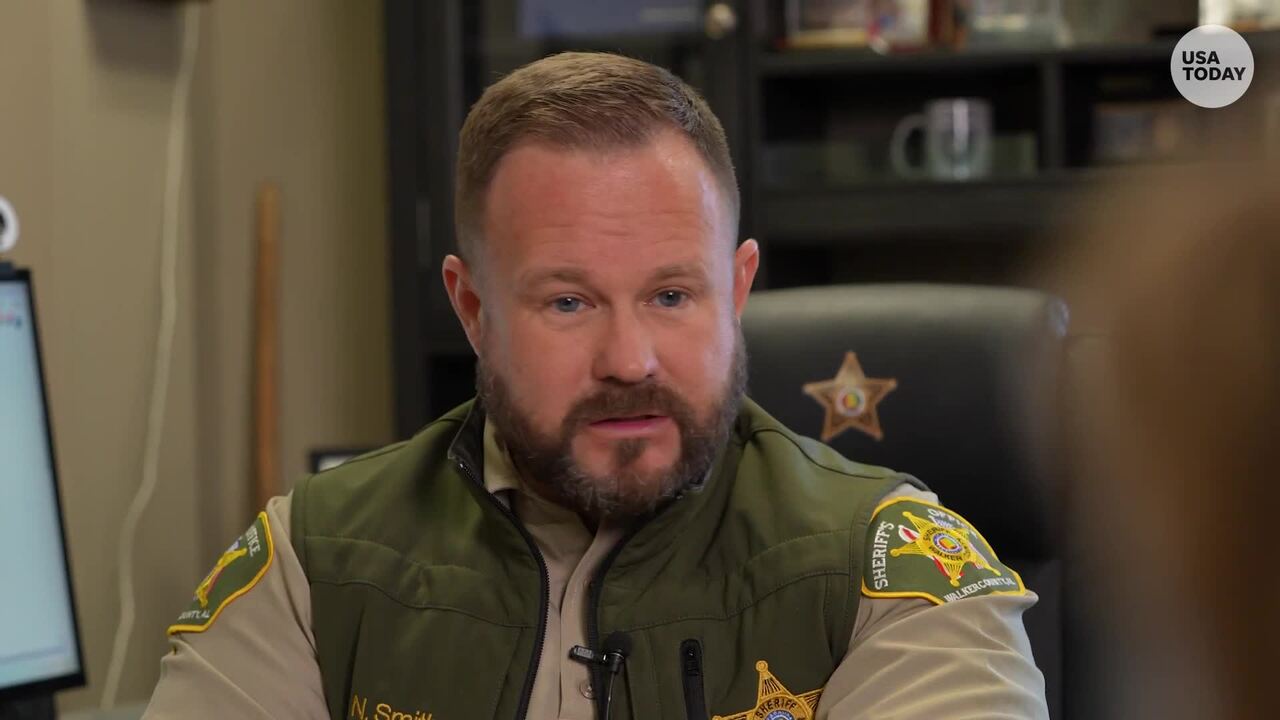
After ushering a reporter inside, Smith tilts his head back and peers across his desk, where papers are folded and arranged with geometric precision. He proffers a stack of printouts he says will prove his innocence — his lack of culpability.
Down a flight of stairs from where Smith sits, into a chill that grows with every step, Anthony "Tony" Mitchell slowly froze to death in a concrete cell in January 2023. About 100 feet from the sheriff's immaculate enclave, jailers who worked for Smith jeered as Mitchell shivered in his own waste, court records show.

A short walk from that cell, where the floor of the sheriff's office forms the ceiling of the Walker County Jail, a group of guards beat a man until one of their uniforms was soaked with his blood, according to court records. Nearby, deputies bribed a prisoner to serve as their enforcer. In the infirmary down the hall, jailers pummeled a man so hard they broke bones.
Three years later, none of it has come back on Smith. He struts calmly through the spaces where these things occurred, proudly pointing out the improvements he has made. Cameras over here. Monitors to track inmates' breathing over there. Supplies stacked in the bare cell where Mitchell once lay dying. As Smith walks, he has a habit of taking hold of the lapels of his Army-green vest, shrugging it forward in a muted facsimile of The Fonz.
"As long as I'm sheriff, … that cell is never being used again," he says, passing by the concrete box where Mitchell spent his final days.
Despite his outward calm, Smith is a man under siege. His watery blue eyes, narrow-set and preternaturally unblinking, reveal nothing of the pressure bearing down upon him. Under his reign at the apex of law enforcement in this rural Alabama county, 20 of his employees — nearly half the jail staff at the time of Mitchell's death — have been indicted in a sweeping federal investigation that also included five health care contractors.

As of early March, 13 defendants had pleaded guilty, admitting they violated the dead man's civil rights in the jail Smith ran from upstairs. Another worker entered a guilty plea stemming from a different incident.
The details laid out in court records detail abuse and neglect: One of the deputies who arrested Mitchell stomped on his groin as he lay handcuffed on the ground, telling him, "This is how we treat seizures in Walker County." A jailer tased Mitchell as he shivered in his cell. He depended on the guards for water, but they rarely brought him any. He needed medical care, but they wouldn't unlock the cell door for the nurses for two weeks. When they finally took him to the hospital, he was unconscious and cold, his body nearing the final stage of hypothermia.
Still, Smith remains in power.
Federal prosecutors have not charged him in connection with Mitchell's death. If he wins an upcoming election, a felony conviction may be the only thing that could force him from office.
In Alabama, it's extraordinarily difficult to oust an elected sheriff, and Smith is determined to cling to power as long as he can. The localdistrict attorney has filed unrelated misdemeanorcharges against him forhiring unqualifiedpeople, but Smith is fighting the charges. Even if he's convicted, he won't automatically lose his job because they're not felonies. A state board has voted to strip him of his law enforcement certification for the same reason, but under Alabama law, sheriffs don't need to be certified. The Walker County Commission says its hands are tied, and Smith has the authority to run the sheriff's department "as he sees fit."
And whileSmith faces three challengersin his bid for a third term as sheriff, plenty of Walker County residents believe he will cruise to victory, despite the violence that unfolded just down the stairs from his office.

"He needs to be held accountable for the failure of a sheriff and a man that he is," said Ryan Cagle, a local pastor and activist who has worked to keep Mitchell's memory alive. "Not as some supervillain, but this is a southern gothic — just a ridiculously deep and dark and wicked thing."
Mental illness was a death sentence in jail
At first,Steve Mitchelldidn't recognize the man who showed up at his door on January 12, 2023.
Wearing socks but no shoes as the temperature hovered around 60 degrees, the man stooped, his dirty clothes hanging off his lanky 6'5" frame like a scarecrow's. His hair flopped greasily over his ears.
It had been about three months since Steve had seen his 33-year-old cousin, Tony Mitchell, at Tony's father's funeral, but the transformation was unsettling. Haggard and emaciated, Tony looked to have lost more than 50 pounds, according to court documents.
Even more shocking than his appearance were the words coming out of Tony's mouth: He had found two portals in his house, he told Steve. One of them led to heaven, the other to hell.
There was more: In a box in the attic rested the remains of his older brother, stillborn in 1984, Tony insisted. He had to retrieve the box and put it in the portal to heaven, and he needed Steve's help to do it.

Terrified, Steve dialed 911 and asked for an ambulance.
By the time deputies made their way down the long driveway off Lost Creek Road to the house Tony once shared with his father, the onetime jokester and basketball player had lost all sense of reality. He had spray-painted his face black, in readiness to traverse the portal to hell. Confronted by a horde of officers, he ran off into the woods. According to a criminal complaint, he fired at least one shot in their direction before he fled.
Quickly caught, Mitchell soon found himself locked in a bare concrete cell known as "BK 5" at the Walker County jail, alone with his demons at the bottom of the stairs.
No bunk.No toilet.No running water.
Just a grate in the middle of the floor for your soul to slip away through.
After Mitchell's arrest, the sheriff's department released a photo of him, handcuffed, his face still blackened. On Facebook, the Walker County Sheriff's Office touted the arrest as a brave win.

"This situation could have ended much differently if it weren't for the constant training of our department, incredible work by our dispatchers, (and) assistance from other agencies," the post said, in part. "Thankfully, the day ended with everyone safe."
According to a lawsuit later filed by Mitchell's family, that's what the sheriff's office told them, too – that he was safe and would get help in jail.
While the arrest was traumatic for Mitchell's cousin, sister and mother, they also couldn't help but feel some relief. Mitchell had been spiraling since his father died, according to his sister, Maranda Mitchell-Gutzmer. Like so many in Appalachia, he had fallen into an abyss of drug abuse and paranoia.
A phone call with Mitchell a few days earlier had alarmed his sister, who had moved to the Chicago area years earlier to "escape" Walker County.
"He wasn't even making sense, and I just remember crying and being like, 'Please, please get help,' " said Mitchell-Gutzmer, who had recently given birth to her first child. "And he just was silent. I can hear him weeping, and I'm just like, 'Please — I want my daughter to be able to meet you.' "
Maybe her brother had hit that place people call "rock bottom," Mitchell-Gutzmer reasoned. Maybe what he needed was to be locked up, away from temptation, away from drugs. Surrounded by professionals who would provide him with medical care.
If nothing else, he'd be safe, she thought.
In those first few days, Mitchell-Gutzmer and her mother called the sheriff's office incessantly. They were given scant information, but what Mitchell-Gutzmer eked out of a woman who answered the phone offered some hope.
"They said that they're waiting for him to detox because he doesn't know what's going on," she said. "It's just sort of reassuring — like: 'We're handling this for you.' "

Whoever answered the phone, the family's lawsuit says, was echoing what deputies had promised Mitchell's mother and cousin: They would get him help once he was in custody.
A jail cell nicknamed 'the freezer'
The temperature doesn't change much when you step into the Walker County Jail from outside.
Just inside the door is Medical, a small, musty room where the rules require recently arrested people to be evaluated before being locked in a cell.
But the health services administrator on duty the evening Mitchell was taken into custody "wanted to wait," court records show, even though Mitchell couldn't walk. He could barely stand up.
He also couldn't change his clothes. Deputies stripped off his dirty outfit, but they couldn't get him into the orange jail-issue replacement. Instead, they pulled a one-piece garment known as a suicide smock over his head.
The specks of warmth salvaged from the inside of the patrol car, which had clung to his skin under his gray sweatpants and hooded striped sweatshirt, soon fell away.
As his mother and sister were assured Mitchell was safely detoxing, guards took away his sleeping mat and eventually even the smock, leaving him naked on the floor of the infamous BK 5 – booking area cell number five, nicknamed "the freezer," the family's lawsuit says. An empty concrete box with no bunk, no sink and no toilet, BK 5 was meant to be a holding cell, a place where people stay for a few hours until they sober up, bail out or move into the jail's housing unit.

Mitchell was locked inside BK 5 for 14 days. He was dependent on jailers for everything – food, water, trips to the bathroom.
Guards gave him food, but after one of them tased him a few days into his confinement, he couldn't chew it. Mitchell's drug abuse had ruined his teeth, so he wore dentures. The shock from the jailer's weapon caused them to fly out of his mouth, and he never got them back.
The paper bags and takeout-style containers the guards gave him at mealtimes didn't include anything to drink, the family's lawsuit says, and for the last 70 hours before he died, no one brought him any water until, finally, he was too weak to drink it.
According to the lawsuit, jailers brought Mitchell to the toilet and shower only six times the entire two weeks he was there – not even once every two days – and his cell became soiled with feces. After his showers, he was returned, naked and cold, to the filthy, freezing cell.
Deposing a king
Alabama once boasted thousands of acres of "white gold" — cotton that enriched landowners who enslaved hundreds of thousands of people to work the fields.
After the slaves were freed and cotton was no longer king, a different sort of richness was pulled from the ground in Walker County. The mineral wealth that flowed into landowners' pockets is reflected in place names to this day: Coal Valley. Carbon Hill. Coal Mine Road.
The tiny minority that held this fragile wealth has long needed protection, both from the vast numbers of oppressed people needed to extract it and from the federal government determined to protect them.
"Good ole boy" networks arose as local families banded together to protect their legacies and each other, elevating their favorite sons to the highest law enforcement position in the land: County sheriff.

Whether by emotional manipulation, fear or a shared hatred of a common enemy – the federal government – poor and working-class citizens continue to fall in line, allowing those with power to keep it, said Susan Pace Hamill, a professor emerita of law at the University of Alabama.
"Getting rid of a sheriff in a smallish Alabama community is like deposing a king," she said.
Smith managed to do it in the 2018 election, when he defeated an incumbent sheriff in the Republican primary and went on to win the general election with 60% of the vote.
He took office at age 35, among the youngest in the state to ever hold the position. Smith prevailed in the primary again in 2022 and easily won a second term in this Republican stronghold, where Democrats haven't put up a serious general election fight in recent years.
In interviews and campaign videos, Smith insists he's not a good ole boy, but a local boy made good.
Growing up in the county seat of Jasper, he played football for the local Curry High School yellowjackets. He's spent his entire law enforcement career in Walker County, first in the town of Parrish, where he rose to the rank of chief, and then as chief in the city of Cordova.
Smith and his wife, Tabatha, who married in 2006, are the parents of four children, three of whom they adopted from foster care. They attend the Living Light Church of God.
"God called us to be leaders, and He called us, again, to be his hands and feet,"Tabatha Smithsays in a video urging voters to elect her husband to a third term. "We were called to greater."
Smith says when he took over as sheriff, the jail was like "a third world country," covered in graffiti and with just one or two working toilets. More than 400 people were confined to the facility, which was designed for 250. It now averages about 130 to 140. But even today, many of the prisoners are suffering from mental illness, Smith says. They should be in treatment but ended up in jail because there aren't enough beds.
"We got a guy that's been here three years on a waiting list. What do I do with him?"
Smith throws up his hands in exasperation.
"What am I supposed to do with him? I have put him in every county jail in northern Alabama just to give our people relief from having to deal with him, because he's just that type of inmate. And then usually they'll make it two or three days or a week, and then they're sending him back."
Faced with such challenges, it's a point of pride for Smith that only four people have died in the jail on his watch, compared with nine under the previous sheriff.
Getting that number to zero, the sheriff says, would be impossible.
"Can I say, '… There won't never be another person die in this jail?' I can't say that," Smith told USA TODAY. "Because if you put 200 people, 100 people, 150 people, 400 people in one building, that are sick, you can't never make that promise to somebody."
'He gets what he gets since he shot at cops'
As Mitchell wrapped his arms around himself and pulled his knees to his chest, trying to keep warm, guards told nurses he was too combative for a medical evaluation and refused to open the cell. Twice, a mental health practitioner tried to speak with him through a tiny window in the locked door but didn't get very far.
During every shift, at least one jailer would say something like, "F--- him. He gets what he gets since he shot at cops," according to federal plea agreements.

Two weeks passed before a guard finally unlocked Mitchell's cell for a nurse. It took less than three minutes for her to decide he should go to the emergency room.
No one called 911.
Instead, more than three hours later, a supervisor told two deputies to drive him there.
Advertisement
Leaked surveillance video shows what happened next:
The deputies lifted Mitchell's limp body into a wheelchair. Almost immediately, he slid forward onto the floor. After the deputies put him back into the chair, Mitchell's body stiffened, with his legs straight in front of him and his head lolling back. The jailers lifted him from the chair and put him back on the cell floor as a handcuffed woman entered the booking area.
A few minutes later, they carried him to their waiting SUV and shoved his motionless body into the back seat.
Mitchell had no pulse when he arrived at the hospital around 9:20 a.m. on January 26, 2023 — five hours after the jail nurse found him dehydrated and "cool to the touch."
Along with sepsis, his cause of death was hypothermia. His body temperature was 72 degrees.
'Please don't kill my son'
Smith faults the county's hiring process for some of his employees' behavior.
Whenever he has a job opening, he gets a list of the three people who have scored highest on a civil service test and says he has no choice but to hire one of them – whether he thinks they're fit for the job or not.
"Let's say I know that this guy is an alcoholic. And I know that this guy beats his wife on Sundays, just because it's a small town. This guy has a drug problem, but he ain't never been arrested, and he's studied enough to pass his test. … I could know those things, but I gotta' hire one of these three."
A review of the written civil service rules shows what he's saying is true.
But the rules didn't stop Smith from later naming one of the guards involved in Mitchell's death Rookie of the Year.

They didn't stop him from firing people, and he had no trouble getting rid of the jailer who leaked the video of Mitchell.
They also didn't force him to hire his friend John "J.J." Jackson. In fact, a loophole in the rules allowed Smith to give Jackson a job without a formal background check. Such a check would have found at least three lawsuits that alleged excessive force.
About two years after Smith hired him, on Feb. 26, 2021, Jackson responded to a 911 call from Frederick Earl Hight Sr.
Hight wanted an ambulance for his 26-year-old son, who suffered from paranoid schizophrenia. The father told the dispatcher there were no guns in their house and begged for calm:
"I don't want my son shot. I don't want my son shot," Hight said. "Please don't shoot him. Taser him or something if he gets like that. Because he said to me he wants to kill cops. … Please don't kill my son."
Jackson arrived around 8 p.m. to find the worried father waiting outside in the evening chill.
Cellphone video reviewed by USA TODAY shows what happened next: Jackson went into the trailer. He outweighed Frederick Earl Hight II, slim in a dark bathrobe, by about 60 pounds. The younger Hight grabbed a kitchen knife, and Jackson drew his gun.
"You've got a weapon, I've got a weapon," Hight said.
Jackson ordered Hight to drop the knife, which he immediately did. He walked into the living room with his hands up and quickly followed Jackson's demand to get on the ground.
"What does this have to do with?" Hight asked repeatedly from the floor. The deputy didn't answer.
"I'll (expletive) you up. I'll (expletive) you up, son," Jackson yelled, struggling to handcuff Hight with one hand while pointing the gun at him with the other.
"Dad! You better … say something!" Hight called out, starting to get up.
"I'm going to shoot you," Jackson shouted. "I'm going to shoot you."

"That ain't even a gun. Joke's on you," Hight replied. "Joke's on you."
Jackson fired. Hight slumped to the ground.
Jackson glanced down at the man he'd just shot to death and said: "I told you. And I'll do it again."
Jackson could not be reached for comment. He told the State Bureau of Investigation Hight was trying to grab his gun. Jackson also stated that he couldn't be sure if Hight, briefly alone in the kitchen, had picked up another knife or a gun. When Hight said "joke's on you," Jackson took it as a threat, he told investigators.
When the video footage sparked outrage, Smith accused the public of rushing to judgment "to vilify a good man."
"To see people of this community attack a deputy based on a 90-second clip of a video that would have 90% of them peeing down both legs if they were in that same situation makes me sad more than anything," Smith wrote in an op-ed in the Daily Mountain Eagle.
State investigators forwarded their report to the local district attorney, who declined to charge Jackson with any crime.
In his deposition in a civil suit later filed by Hight's father, Smith's chief deputy explained that because Jackson initially worked part-time, the civil service process didn't apply to him. So Jackson didn't have to take a test or get his name on a list.
Jackson also didn't have to do those things when he switched to full time. And no one at the sheriff's office called his previous employers or his references. They also didn't check for lawsuits against Jackson. If they had, they would have discovered the three times Jackson had been sued for using excessing force, twice against people with mental health issues.
In his own deposition, Smith said he had known Jackson for 20 years.
"People in this county love him," the sheriff said.
After the state investigation ended, Smith returned Jackson to duty as a Walker County sheriff's deputy.
He now works as a school resource officer.
'We did it. We killed him.'
Back in his climate-controlled office, Smith won't concede Mitchell was treated badly.
There could be more to the story, the sheriff says. Security cameras may have captured something that supports a different conclusion. He says he doesn't know.
"I have not, to this day, watched the 300-something hours of video footage, because I do not want to put myself into that position," Smith says. "It's easy to make the determination that you're saying when you're spoon-fed, every day, a handful of videos."

Pressed to provide a single minute of footage that exonerates his deputies or his own leadership during the two weeks Mitchell suffered in a cell just downstairs from his office, Smith offers a rare blink. He can't do that, he says. It might interfere with the ongoing federal investigation.
What about the people who have pleaded guilty, admitting what they did to Mitchell was a crime?
Smith bobs and weaves around the question.
Maybe they were scared, he says. Maybe they were forced. He doesn't want to jeopardize the defense of the "good people" who have been charged in connection with Mitchell's death. It's an open investigation, and everyone deserves their day in court.
In court documents, however, several of those same defendants, like former jailer Joshua Conner Jones, haven't minced words. They have clearly admitted responsibility for what happened to Mitchell.
"Collectively we did it," Jones told federal prosecutors. "We killed him."
A spokeswoman for the U.S. attorney's office in Northern District of Alabama, which is overseeing the investigation, said she couldn't comment because it is ongoing.
A review of court dockets shows prosecutors seem to be following a well-worn pattern in federal law enforcement: persuade the lower-level players to cooperate and flip on the ringleader.
The wild card is the man in the White House. President Donald Trump has ended federal oversight of police departments that have violated peoples' civil rights. And at the Justice Department's Civil Rights Division, which in the past assisted with such cases, at least 250 lawyers have left or been reassigned since Trump's second term began.
Whatever happens, Smith says he refuses to live in fear.
"I don't live a life worrying every day," he told USA TODAY. "I can't sit back and worry about things that I don't have control over."
If you're looking for the perfect sheriff, Nick Smith isn't it
Shortly after he moved into his second-floor office in 2019, Smith added more than 100 security cameras at the jail. Those were the cameras that captured the guards' abuse and neglect of Mitchell four years later.
Smith says he had wanted to make more changes at the jail when he first took office, but the county commission wouldn't approve the money for improvements until after Mitchell's death.
Since then, Smith has increased jail health care staffing from eight hours per day to 16. But there were nurses on duty when Mitchell was arrested and for much of his time in custody. They just didn't examine him.
Smith has installed state-of-the-art monitors that sound an alarm when an inmate's breathing slows or their heart rate drops. But Mitchell didn't die because the guards didn't know he was suffering. He died because they didn't care.

"Those systems wouldn't have changed anything for Tony. … They knew what was going on," said Cagle, the activist. "The issue is not because there wasn't the right equipment. The issue is because there was a culture of abuse and harm."
The one change that may have saved Mitchell hangs on the wall just inside the jail's entrance: a sign. It reads, in part:
Any arrestee exhibiting any of the following behavior or characteristics should be denied admission to the jail until evaluated by an emergency facility:
◦Persons who are unconscious or in and out of consciousness
◦Persons who cannot walk under their own power
◦Persons who are having or have recently had convulsions/seizures
◦Persons exhibiting apparent hallucinations, delusions or diminished capacity to communicate or comprehend
If the sign had been there in January 2023, would Mitchell have ended up in a cell?
"No," Smith bluntly says three years later.
And he admits he still doesn't hear about everything that happens down the stairs from his office.
"It's a chain of command," he explains. "I don't have the ins and outs of every movement throughout the day."
Still, he says transparency and accountability have improved under his watch. That's what he focuses on when he knocks on voters' doors.
"I tried to do the right things, and I tried to do the right steps," he said. "And I tell people when I'm out campaigning, or asking for their vote: 'If you're looking for the perfect sheriff, I'm not it.'"
The Republican primary is set for May 19. The average high for that date is 81 degrees.
Will Carlesscovers extremism and emerging issues for USA TODAY.He reported from Jasper, Alabama.
Gina Barton is an investigative reporter at USA TODAY. She can be reached at (262) 757-8640 orgbarton@gannett.com. Follow her on X@writerbartonor on Bluesky@writerbarton.bsky.social.
This article originally appeared on USA TODAY:Mental illness was a death sentence for an Alabama prisoner
JASPER, AL — On a brisk December morning inWalker County, Alabama, the temperature in Sheriff Nick Smith's office is ...





 Oprah Winfrey ran her first marathon at the Marine Corps. Marathon in Washington D.C. on Oct. 23, 1994. The 40-year-old ran it in 4 hours 29 minutes and 20 seconds in wet conditions." style="max-width:100%; height:auto; border-radius:6px; margin:10px 0;" loading="lazy" />
  "Orange Is the New Black" star Uzo Aduba ran the 2015 Boston Marathon to support Boston's Dana-Farber Cancer Institute on April 20, 2015 in Boston, Mass. The Boston-area native joined Dana-Farber Marathon Challenge (DFMC) team to raise funds for cancer research and finished with a time of 5 hours 3 minutes and 24 seconds. She was a sprinter at Boston University." style="max-width:100%; height:auto; border-radius:6px; margin:10px 0;" loading="lazy" />
  Singer Alicia Keys (C) tackled the TCS New York City Marathon in New York on Nov. 1, 2015 to raise funds for her Keep a Child Alive charity organization. Her finish time was 5 hours 50 minutes and 52 seconds." style="max-width:100%; height:auto; border-radius:6px; margin:10px 0;" loading="lazy" />
  Natalie Dormer completed the Virgin London Marathon on April 24, 2016, with a time of 3 hours 51 minutes and 21 seconds—slightly slower than her 2014 race." style="max-width:100%; height:auto; border-radius:6px; margin:10px 0;" loading="lazy" />
  Yaniv "Nev" Schulman celebrated as he crosses the finish line during the 2021 TCS New York City Marathon in Central Park on Nov. 7, 2021. Nev finished with a time of 3 hours 22 minutes and 43 seconds, about a 7:44 per mile pace." style="max-width:100%; height:auto; border-radius:6px; margin:10px 0;" loading="lazy" />
  Cynthia Erivo completed the 2022 TCS London Marathon on Oct. 2, 2022 with a time of 3 hours 35 minutes and 36 seconds. She also ran the NYC marathon in under 4 hours." style="max-width:100%; height:auto; border-radius:6px; margin:10px 0;" loading="lazy" />
  Kevin Hart (with race director Peter Ciaccia) finished the 2017 TCS New York City Marathon in 4 hours 5 minutes and 6 seconds." style="max-width:100%; height:auto; border-radius:6px; margin:10px 0;" loading="lazy" />
  Amy Robach (left) and T. J. Holmes spent St. Patrick's Day participating in the 2024 United Airlines NYC Half Marathon in New York City. Amy and T.J. finished this race with a time of 1 hour 57 minutes and have run multiple marathons together." style="max-width:100%; height:auto; border-radius:6px; margin:10px 0;" loading="lazy" />
  Actor Ashton Kutcher crossed the finish line at the New York City Marathon with Andrew Harding Nov. 6, 2022. He ran a 8:56 per mile pace to finish with a time of 3 hours 54 minutes and 1 second." style="max-width:100%; height:auto; border-radius:6px; margin:10px 0;" loading="lazy" />
  Gordon Ramsay completed the Virgin London Marathon on April 22, 2012, in 4 hours 26 minutes." style="max-width:100%; height:auto; border-radius:6px; margin:10px 0;" loading="lazy" />
  Valerie Bertinelli completed the Boston Marathon four days before her 50th birthday April 19, 2010 in Boston. The actress ran the prestigious race to raise funds and awareness for the Dana-Farber Cancer Institute. Her finishing time was 5 hours 14 minutes and 37 seconds." style="max-width:100%; height:auto; border-radius:6px; margin:10px 0;" loading="lazy" />
  Christy Turlington Burns crossed the finish line at the London Marathon April 26, 2015, with a time of 3 hours 46 minutes and 45 seconds. She raced to raise funds for Every Mother Counts, her non-profit to help make pregnancy and child birth safer." style="max-width:100%; height:auto; border-radius:6px; margin:10px 0;" loading="lazy" />
  Teri Hatcher posed before the New York City Marathon on Nov. 2, 2014. She ran the race in 5 hours 6 minutes and 42 seconds. She ran again in 2018 with her daughter Emerson Denny to raise money for Save the Children." style="max-width:100%; height:auto; border-radius:6px; margin:10px 0;" loading="lazy" />
  Katie Holmes crossed the finish line of the New York City Marathon in New York Nov. 4, 2007 with a time of 5 hours 29 minutes 58 seconds." style="max-width:100%; height:auto; border-radius:6px; margin:10px 0;" loading="lazy" />
  Chelsea Clinton celebrated her finish time of 4 hours 20 minutes and 34 seconds at the TCS 2022 New York City Marathon on Nov. 6, 2022. According to New York Road Runners, she has run the marathon three times; her fastest was 3 hours 45 minutes 51 seconds." style="max-width:100%; height:auto; border-radius:6px; margin:10px 0;" loading="lazy" />


