
New footage of federal immigration agents fatally shooting an unarmed U.S. citizen has thrust a family's yearlong quest for more information into the national spotlight.
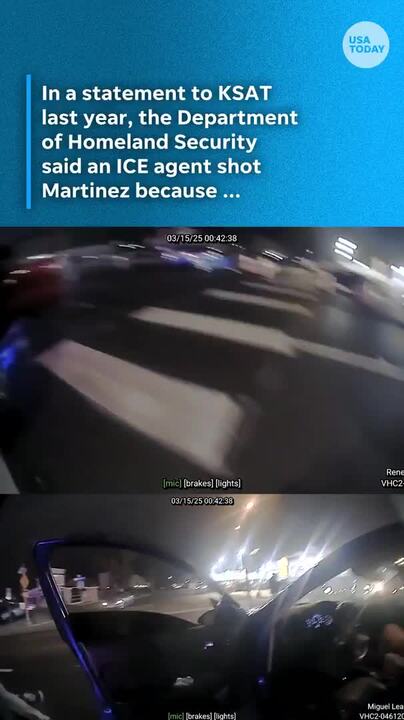
Videos and records released by Texas officials are raising new questions about theDepartment of Homeland Security's version of events that led to the killing of Ruben Ray Martinez during a chaotic traffic scene.
Nearly a year has passed since the Homeland Security Investigations (HSI) agent fired at close range into Martinez's car at the scene of a late-night traffic accident on March 15, 2025, in South Padre Island, a resort town off the southern coast of Texas. Officials said Martinez, 23, accelerated his vehicle at an agent, an account his family had long disputed.
Little was known about the case − which involved local, state and federal law enforcement − for months. Martinez, an Amazon and Walmart worker from San Antonio, was the first U.S. citizen killed by federal agents amid theTrump administration's aggressive approach to immigration enforcement.


Protests, anger in Minneapolis after 2nd person fatally shot
But Martinez's case came into the spotlight only after the killings of Renee Good and Alex Pretti, two U.S. citizens killed by immigration agents in Minneapolis in January. Good and Pretti's killings have drawn scrutiny by Americans andcongressional lawmakers from both partiesabout federal agents' tactics.
Though the killings occurred during immigration enforcement operations, agents shot Martinez while they were helping local law enforcement control traffic at an intersection in a popular spring break destination.
Martinez's mother, Rachel Reyes, has brought attention on her son's case, even as she said she supported PresidentDonald Trump.
Information on Martinez's case came through a watchdog group's release of an internal Immigration and Customs Enforcement document. ICE's internal report,obtained by the nonprofit watchdog American Oversight, said Martinez "accelerated forward" into an officer. HSI Supervisory Special Agent Jack Stevens told Texas officials he shot Martinez three times out of fear, according to a memorandum.
Martinez's family and his best friend, Joshua Orta, the lone passenger in the vehicle, have strongly disputed the government's account. Family lawyers said video footage released by state officials backs up their suspicions, but they are seeking more evidence.
"It is clear that these ICE officers have used, in their statement, dramatic language," Butch Hayes, one of Reyes' lawyers, said in an interview. "And that dramatic language does not match up with the videos that we have seen."
On Feb. 25, a Cameron County grand jury didn't find probable cause to indict the federal agent in the shooting, the Texas Tribune reported. Orta, 25, died in an unrelated car accident days before the grand jury decision.
Todd Lyons, acting ICE director, said the agency stood "by the grand jury's unanimous decision that found no criminality."

"This incident was investigated from every possible angle by an independent body, and it cleared our officer," Lyons said in a statement.
The Texas Department of Public Safety, which investigated the shooting and releasedevidence on March 6, didn't respond to emailed questions. The South Padre Island Police Department didn't respond to requests for comment. It was unclear whether the federal agents in the shooting had body cameras.
Local police body-worn cameras and local businesses' surveillance videos paint a grainy and incomplete picture of what happened in the intersection.
In a statement, Chioma Chukwu, executive director of American Oversight, said the case was part of a "troubling pattern" of escalating use of force, delaying disclosures and "misleading information about incidents involving deadly force."

What happened in Martinez's killing?
Nearly a year ago, Martinez and Orta visited their friends' condo in South Padre Island, according to a draft witness statement by Orta before his death, which Reyes' lawyers provided to USA TODAY. Local and state investigators also interviewed Orta, the substance of which was included in the state evidence released in March.
Martinez's birthday was days before the shooting, and he and Orta went out on a late birthday celebration. That night, Martinez and Orta drank alcohol, failed to get into a club, and had gone to eat at Whataburger, Orta's statement said.
Advertisement
On their way back, they arrived at the scene of the accident. They had a bottle of Crown Royal whiskey and marijuana in the car, evidence records showed. Toxicology results later showed Martinez's blood alcohol content was 0.124%, above the legal limit, and he had marijuana and the anti-anxiety medication alprazolam, commonly known as Xanax, in his system.
Orta said Martinez seemed nervous about alcohol in the car, and he told investigators Martinez was "jittery" with police and he panicked. Orta said Martinez never meant to hurt anyone.
In surveillance footage, Martinez's Ford Focus is seen driving slowly behind an ambulance as local law enforcement officers from different agencies slowed traffic. The footage shows a line of cars in a left turning lane, while Martinez's vehicle is in open lanes near police vehicles. Martinez brakes at several points.
In body camera footage, an officer is heard saying he saw an open container in Martinez's car. In footage, an officer tells Martinez to keep going. Officers from behind Martinez's car yell to stop the vehicle.
"Stop him," one officer yells repeatedly, according to the video, and then yells, "Get him out."
Martinez slows at one point as an officer waves pedestrians through, another video shows. "Where is he going?" the officer at the crosswalk says toward Martinez's vehicle. "Hey, where you going?"
Then Martinez's car rolls forward. "Hey, stop him," the officer at the crosswalk says.

Video disputes agents' accounts
In the middle of the intersection, two HSI agents appear to try to stop him.
Martinez's car is then seen stopped. HSI Special Agent Hector Sosa is seen standing in front of the vehicle. Sosa told Texas Rangers, "The driver accelerated forward, striking myself and ended up on the hood of the vehicle."
The video shows Martinez's car slowly turn left as officers move toward the car. Orta's statement said Martinez had tried to turn the car around to leave.
Inan angle captured by The New York Times, video shows Sosa pressed against the front of the car and he appeared to be on the hood. Orta told investigators that the car was moving slowly and that Sosa was on the hood, as if the car caught his feet.
Sosa's email signature said he is a "Defensive Tactics Instructor Coordinator" and "Body-Worn Camera Coordinator." It was unknown whether he or Stevens, who shot Martinez, had body-worn cameras. When reached by phone, Sosa declined to comment.
Video shows Stevens, who was close to the driver's window, open fire into the vehicle. There were no warnings or commands when Stevens fired into the car, Orta said in the witness statement. Stevens didn't respond to requests for comment.
In his memorandum to Texas Rangers, Stevens said that he could smell marijuana, that he could see "the driver's eyes were open widely, his fist clenched to the steering wheel," and that Martinez looked past the officers on the scene while failing to comply with verbal commands from multiple law enforcement officers.
Stevens said he feared for the "safety and life of SA Sosa, myself, the local law enforcement officers immediately in the path of the vehicle, and the pedestrians present in the area traversing the crosswalks and sidewalks in the path of the vehicle." He said the 2025 New Orleans vehicle ramming attack was "still fresh on my mind."
In the aftermath of the shooting, footage shows Stevens pulling Martinez out of the vehicle. He forces Martinez face down on the pavement and handcuffs him. Sosa said he took Orta out of the passenger side.
After Martinez was handcuffed, first-responders began giving Martinez CPR compressions, video shows. In footage, Orta is seen sitting in the middle of the crosswalk with his hands cuffed behind his back, on the other side of the car from Martinez.
This article originally appeared on USA TODAY:What video of Ruben Ray Martinez killing by DHS agent shows